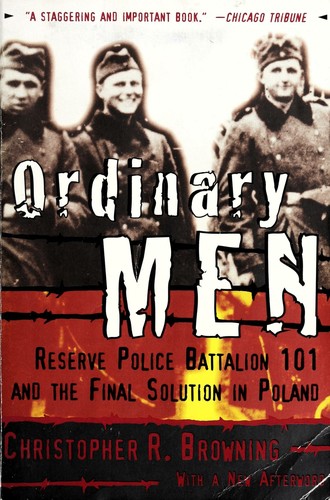
Ordinary Men
First published: 1998
Description
Christopher R. Browning’s shocking account of how a unit of average middle-aged Germans became the cold-blooded murderers of tens of thousands of Jews.
*Ordinary Men* is the true story of Reserve Police Battalion 101 of the German Order Police, which was responsible for mass shootings as well as round-ups of Jewish people for deportation to Nazi death camps in Poland in 1942. Browning argues that most of the men of RPB 101 were not fanatical Nazis but, rather, ordinary middle-aged, working-class men who committed these atrocities out of a mixture of motives, including the group dynamics of conformity, deference to authority, role adaptation, and the altering of moral norms to justify their actions. Very quickly three groups emerged within the battalion: a core of eager killers, a plurality who carried out their duties reliably but without initiative, and a small minority who evaded participation in the acts of killing without diminishing the murderous efficiency of the battalion whatsoever.
While this book discusses a specific Reserve Unit during WWII, the general argument Browning makes is that most people succumb to the pressures of a group setting and commit actions they would never do of their own volition.
*Ordinary Men* is a powerful, chilling, and important work, with themes and arguments that continue to resonate today.
*Ordinary Men* is the true story of Reserve Police Battalion 101 of the German Order Police, which was responsible for mass shootings as well as round-ups of Jewish people for deportation to Nazi death camps in Poland in 1942. Browning argues that most of the men of RPB 101 were not fanatical Nazis but, rather, ordinary middle-aged, working-class men who committed these atrocities out of a mixture of motives, including the group dynamics of conformity, deference to authority, role adaptation, and the altering of moral norms to justify their actions. Very quickly three groups emerged within the battalion: a core of eager killers, a plurality who carried out their duties reliably but without initiative, and a small minority who evaded participation in the acts of killing without diminishing the murderous efficiency of the battalion whatsoever.
While this book discusses a specific Reserve Unit during WWII, the general argument Browning makes is that most people succumb to the pressures of a group setting and commit actions they would never do of their own volition.
*Ordinary Men* is a powerful, chilling, and important work, with themes and arguments that continue to resonate today.
Subjects
Germany
Germany. Reserve-Polizei-Bataillon 101
Nationalsozialistische Deutsche Arbeiter-Partei
Nationalsozialistische Deutsche Arbeiter-partei. Reservepolizeibataillon
World War, 1939-1945
German Personal narratives
War criminals
Nationalsozialistische Deutsche Arbeiter-Partei. Reservepolizeibataillon 101
Holocaust, Jewish (1939-1945)
Atrocities
Genocide
World war, 1939-1945, poland
Related Books